
Richmond City Genealogy Records
This page covers the City of Richmond, Virginia's independent city and state capital. Genealogy records for Richmond city are held at the Richmond Circuit Court Clerk at 400 N 9th Street. Note: this is the independent city, not Richmond County, which is a separate rural county in central Virginia with its own courthouse and record archive. The two jurisdictions share a name but have no administrative connection.
Richmond City Overview
Richmond Circuit Court Clerk
The Richmond Circuit Court Clerk is located at 400 N 9th Street, Richmond, VA 23219. This office holds most of the public records for the City of Richmond, including land records, will and estate records, case files, court dockets, UCC statements, and marriage licenses. Most records are available to the public under section 17.1-208 of the Code of Virginia.
Records are open to public inspection during regular office hours. Copies are $0.50 per page and certified copies are $2.00. The Clerk's Office cannot perform legal, historical, or genealogical research on behalf of visitors, but staff can help citizens use and navigate the records. Remote access options are available for certain records. Officer of the Court Remote Access (OCRA) provides access for Virginia attorneys. Secure Remote Access (SRA) is available for land records through a subscriber arrangement.
FOIA contacts for the Richmond Circuit Court are Edward Jewett or Cecelia Hargrove at the same address: Richmond Circuit Court, 400 N 9th St., Richmond, VA 23219. These are the contacts to use if you need to make a formal public records request. For standard genealogy research, an in-person visit to the clerk's office is the most direct approach.
Note: Richmond was created from Henrico County in 1782 and has served as the capital of Virginia since 1780. Records for the Richmond area before 1782 are found in Henrico County's record books at the Library of Virginia and the Henrico Circuit Court Clerk.
Richmond City Genealogy Records
Richmond's record base is extensive. Land records, deed books, and mortgage records are available from the city's founding in 1782. Marriage licenses issued at the Richmond Circuit Court go back through the city's history. Will books and estate inventories cover multiple generations of Richmond families. Court order books and case files document legal proceedings across civil and criminal matters.
Richmond continued to record vital statistics during the 1896 to 1912 gap period when state law did not require uniform registration. That means Richmond has local birth and death records from those years that many Virginia localities do not have. For that window, the records are held at the health department or through the state's collection systems. After 1912, the Virginia Department of Health Office of Vital Records at 804-662-6200 holds statewide birth and death records.
The Library of Virginia at 800 East Broad Street in Richmond holds extensive collections relevant to Richmond city genealogy. This includes microfilmed deed books, will books, court records, and other historical materials. The Library of Virginia is physically located in Richmond, which makes in-person access to both the library and the circuit court clerk feasible in a single day. Their online catalog lists what is available before you visit.
For African American genealogy in Richmond, the Library of Virginia's Virginia Untold collection is a key resource covering records from the antebellum and post-Civil War periods. Richmond's history as the Confederate capital and its significant free Black population before the Civil War make it one of the richer locations in Virginia for African American genealogy research.
Richmond City vs. Richmond County
This is worth clarifying clearly. The City of Richmond is an independent city. It has its own courts, its own circuit court clerk, and its own record archive at 400 N 9th Street. Richmond County is a separate jurisdiction entirely, located in the Northern Neck region of Virginia. Richmond County has its own courthouse and its own record series going back to the colonial era.
If your ancestor lived in or near the city of Richmond, the circuit court clerk at 400 N 9th Street and the Library of Virginia at 800 East Broad Street are the right sources. If your ancestor lived in rural Richmond County, which is east of Fredericksburg near the Rappahannock River, you need the Richmond County circuit court clerk's office and the Library of Virginia's Richmond County record collections.
Many genealogy researchers confuse these two jurisdictions because they share a name. The key difference is that the city is in the central Virginia metro area and the county is in the Northern Neck region. Looking at a map of Virginia before starting your research will help you confirm which jurisdiction applies to your ancestor's location.
How to Search Richmond City Records
Visit the Richmond Circuit Court Clerk at 400 N 9th Street. The office maintains indexes for land records, marriage licenses, will books, and case files. Staff can help you identify the right record series. For copies, the fee is $0.50 per page. Bring a name and a date range to make the search more efficient.
Remote access through OCRA is available for Virginia attorneys. The Secure Remote Access system for land records is available through a subscription. For most genealogy researchers, an in-person visit or a formal copy request are the most practical options.
The Library of Virginia is a block away and holds microfilmed and digitized records from Richmond. Their Chancery Records Index, deed book microfilm, and will book collections all contain Richmond city materials. FamilySearch also has indexed Richmond city records, particularly older marriage and probate documents, and is free to search. The Virginia Courts system covers more recent case records online.
Libraries and Local Resources
The Library of Virginia at 800 East Broad Street is the premier genealogy resource not just for Richmond but for the entire state. Their collection includes microfilmed deed books, will books, court records, Bible records, and a vast digital collection. Genealogists visiting Richmond can access both the circuit court clerk and the Library of Virginia in the same trip.
The Virginia Museum of History and Culture, also located in Richmond, holds manuscript collections and family papers from across the Commonwealth. Their research center has appointment-based access to original documents. The Virginia Genealogical Society is based in Richmond and has resources specifically covering the city and surrounding region.
For cemetery research, Find A Grave has substantial documentation for Richmond's many historic burial grounds, including Hollywood Cemetery, Shockoe Hill Cemetery, and Hebrew Cemetery. These are among the most historically significant cemeteries in Virginia and have extensive online documentation.
Richmond City Record History
Richmond was created from Henrico County in 1782 and became the capital of Virginia in 1780. As the state capital and a major commercial center, Richmond generated a large volume of records across all categories from its earliest years. Land records, court order books, and will books from the 1780s are available at the clerk's office and the Library of Virginia. This depth of record makes Richmond one of the richest cities in Virginia for genealogy research.
The Civil War period is heavily documented for Richmond because the city was the Confederate capital from 1861 to 1865. Records from that period include military records, government records, and civilian documents held at multiple archives. The National Archives and the Library of Virginia both hold significant Civil War-era material related to Richmond.
Richmond continued to record vital statistics during the 1896 to 1912 gap period that affected Virginia statewide. Those local records supplement what is available through the state health department. After 1912, the Virginia Department of Health holds statewide birth and death records with consistent registration.
The Richmond Circuit Court Clerk Records page describes what records are available for public inspection, remote access options, copy fees, and FOIA contacts for the city's genealogy archive.
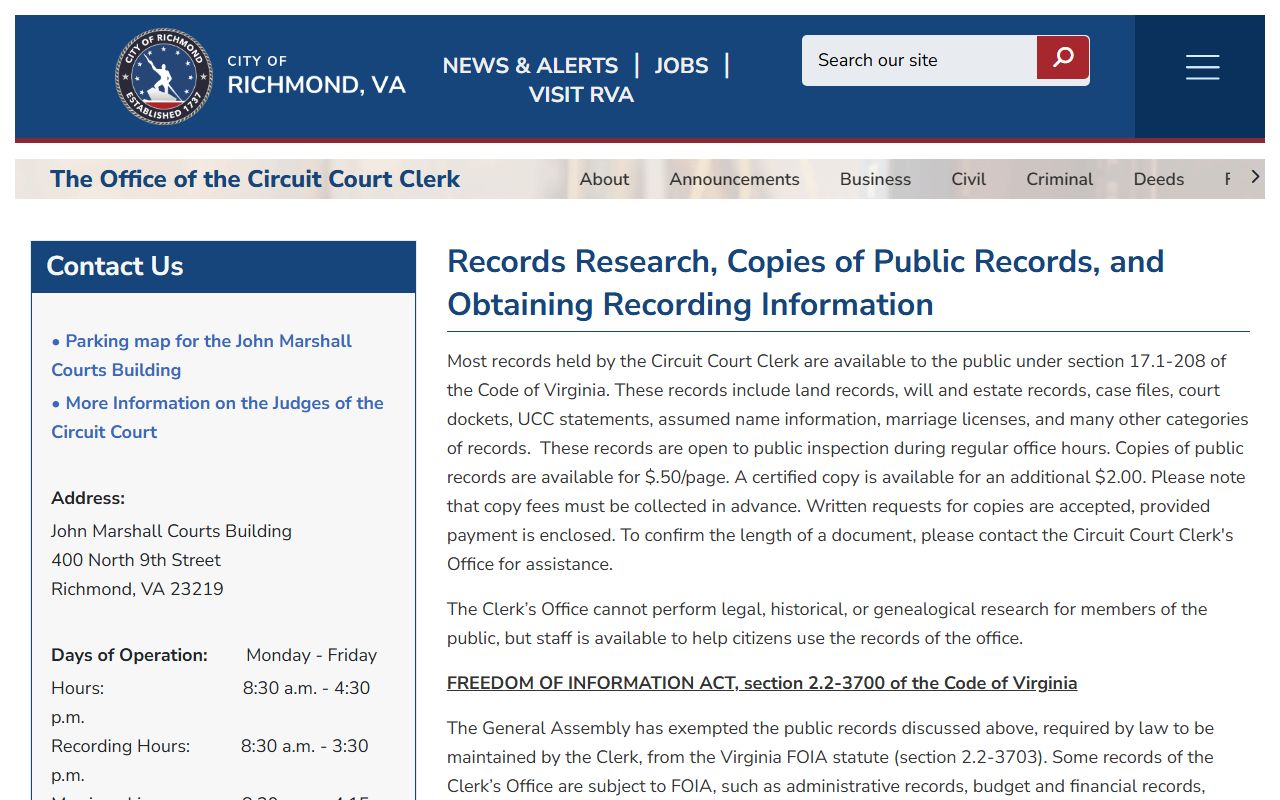
Most records at the Richmond Circuit Court Clerk are open to public inspection. Copies are $0.50 per page and certified copies are $2.00. Staff can help researchers navigate the record series, though they cannot conduct genealogical research on your behalf.
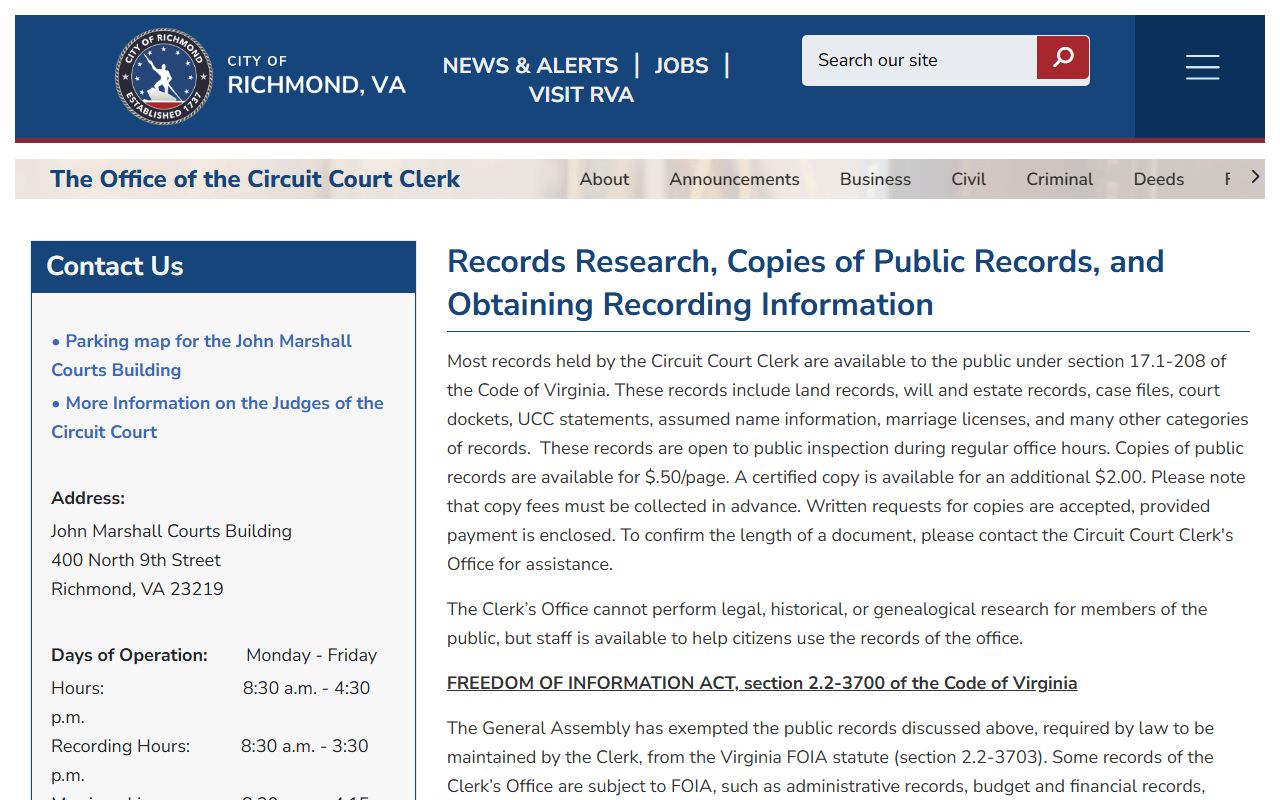
For any genealogy record request, the Richmond Circuit Court Clerk at 400 N 9th Street is the starting point for city records from 1782 forward. The Library of Virginia at 800 East Broad Street is a block away and holds microfilmed and digitized materials from the same period.
Nearby Virginia Cities
These independent cities are near Richmond and each maintains its own genealogy records.